8月20日2026 · 星期四

从 27 条抓取中筛选 12 条 · twitter × 6 账号 · 00:45 UTC 生成

今日信号 · 高度即评分 · 点击直达


  1. GLM-5.3 不换底座,纯靠后训练强化学习将编码能力提升 50%8.0
  2. OpenAI 预览面向零数据保留的私有安全处理8.0
  3. OpenAI Codex 推出安全修复,防止 GPT-5.6 执行破坏性清理命令8.0
  4. Jason Wei:运动如何塑造你的职业大脑7.0
  5. Qwen3.8-27B在Harvey法律智能体基准测试中登顶开源权重模型7.0
  6. Qwen3.8-27B 仅用4天登顶 Cline 本地模型榜首7.0
  7. PaperWM.spoon 通过 Hammerspoon 为 macOS 带来可滚动平铺窗口管理7.0
  8. ai-legal-claude:面向自由职业者的AI合同审查技能包7.0
  9. 丰田基于LangChain构建制造智能体,并用LangSmith进行生产监控7.0
  10. 先质量后成本:AI产品评估的框架7.0
  11. Capso:CleanShot X 的免费开源替代品6.0
  12. Code App 为 iPad 带来完整的类 VS Code 开发环境6.0
018.0

GLM-5.3 不换底座,纯靠后训练强化学习将编码能力提升 50%

智谱联合创始人唐杰透露,GLM-5.3 沿用了 GLM-5.2 的底座(743B 参数的 MoE 模型,每次推理激活约 40B 参数),仅通过一个月在长周期环境中的后训练强化学习,就将编码能力提升了 50%。他强调扩展定律不止于参数规模,并区分了总参数量(知识存储)与激活参数量/有效深度(推理深度)。 这表明后训练可以在不扩大底座模型的情况下带来显著的能力提升,挑战了“参数越大越好”的假设。它凸显了行业向优化推理成本和推理深度转变的趋势,这对于在实际应用中部署高效、高性能的模型至关重要。 GLM-5.3 是一个开源权重模型,拥有 1M token 的上下文窗口,被称为编码能力最强的开源权重模型,在 Z.ai Code Bench 上比 GLM-5.2 提升了 50%。其底座是 743B 参数的 MoE 模型,每次推理仅激活约 40B 参数。唐杰指出,对于漏洞发现等任务,推理深度(走完 20 步推理链)比记忆安全数据库更重要。

@dotey引用推文智谱联合创始人唐杰老师关于 GLM 5.3 以及模型训练的一些分享: 智谱 GLM-5.3 没有换基模底座,纯靠后训练让编码能力提升 50%。 GLM-5.3 模型的底座是 GLM-5.2,约 743B 参数的混合专家(MoE)模型,每次推理只激活约 40B 参数。团队花了一个月,在长周期环境中做强化学习,编码能力比 GLM-5.2 提升了 50%。 这里解释一下 MoE:传统模型每次推理要跑完所有参数,MoE 相当于把模型拆成一群“专家”,每次只调用其中几个,推理速度更快、成本更低。 推文中特别区分了两个概念: 1. 总参数量决定模型学习了多少知识 2. 激活参数量和有效深度决定模型能想多深。 比如说,让模型去找安全漏洞,主要是依赖的是推理能力,能把一条二十步的推理链完整走到底,相对来说各种安全数据库是次要的。 至于为什么不换底座也能大幅提升呢? AI 模型的扩展(scaling)不止堆参数这一条途径。 如果梳理下这些年模型训练的发展路线: - 2020 年 Kaplan 等人的研究建议参数增长要远快于数据,GPT-3、Gopher 都是这个思路的产物。 - 2022 年 DeepMind 的 Chinchilla 论文则认为参数和数据应该同步增长,参数大的模型反而是最浪费算力的。 - 再后来,大家发现模型上线后推理成本远超训练成本,最优解又变成了用更小的模型训更久,比如 Llama-2-7B 每个参数喂了约 290 个 token,Gemma-2-9B 更是喂了 889 个。 模型能力由很多因素决定:底座大小、预训练数据量、每次前向传播的计算量、后训练。 对于现阶段,模型后训练还有很大潜力可以挖掘。展开原推文收起原推文

@dotey

智谱联合创始人唐杰老师关于 GLM 5.3 以及模型训练的一些分享: 智谱 GLM-5.3 没有换基模底座,纯靠后训练让编码能力提升 50%。 GLM-5.3 模型的底座是 GLM-5.2,约 743B 参数的混合专家(MoE)模型,每次推理只激活约 40B 参数。团队花了一个月,在长周期环境中做强化学习,编码能力比 GLM-5.2 提升了 50%。 这里解释一下 MoE:传统模型每次推理要跑完所有参数,MoE 相当于把模型拆成一群“专家”,每次只调用其中几个,推理速度更快、成本更低。 推文中特别区分了两个概念: 1. 总参数量决定模型学习了多少知识 2. 激活参数量和有效深度决定模型能想多深。 比如说,让模型去找安全漏洞,主要是依赖的是推理能力,能把一条二十步的推理链完整走到底,相对来说各种安全数据库是次要的。 至于为什么不换底座也能大幅提升呢? AI 模型的扩展(scaling)不止堆参数这一条途径。 如果梳理下这些年模型训练的发展路线: - 2020 年 Kaplan 等人的研究建议参数增长要远快于数据,GPT-3、Gopher 都是这个思路的产物。 - 2022 年 DeepMind 的 Chinchilla 论文则认为参数和数据应该同步增长,参数大的模型反而是最浪费算力的。 - 再后来,大家发现模型上线后推理成本远超训练成本,最优解又变成了用更小的模型训更久,比如 Llama-2-7B 每个参数喂了约 290 个 token,Gemma-2-9B 更是喂了 889 个。 模型能力由很多因素决定:底座大小、预训练数据量、每次前向传播的计算量、后训练。 对于现阶段,模型后训练还有很大潜力可以挖掘。

@jietang

Thoughts About Scaling Law Scaling, but not only of parameters. Every model release now ends with the same question: how many parameters? It isn't a question that can be answered on its own. Parameter count is only meaningful alongside three others — how much data you have, where you intend to spend your compute, and who will run the model, under what conditions. The field learned this the hard way. Kaplan et al. (2020) fit an exponent that told everyone to grow parameters faster than data — roughly 2.7:1 — and the industry complied: GPT-3, Gopher, MT-NLG. Hoffmann et al. (2022) redid the experiment across four hundred models and found the compute-optimal split is closer to 20 tokens per parameter, and that with sufficient compute the two should grow at the same rate rather than drifting apart. The error in the earlier fit compounded with every order of magnitude of compute, which is why the largest models of that generation were the most misallocated. The trillion-parameter round was, in retrospect, a detour the whole field took together and then reversed. Chinchilla wasn't the end either. It optimized training compute for models that would be trained once and evaluated. Today a model is called billions of times a day and inference dominates lifetime cost. Put inference into the objective and the optimum moves toward smaller models trained far longer — deliberate over-training, which is what Llama-2-7B and Gemma-2-9B were doing at roughly 290 and 889 tokens per parameter. Sparsity moved the target again. In a MoE model two quantities have to be kept apart: total parameters govern roughly how much the model can hold — knowledge, facts, the long tail — while activated parameters and effective depth govern roughly how far it can think, how many steps of a causal chain it can carry before it comes apart. A dense 20:1 ratio does not transfer. And the ratio isn't a single number at all: Roberts et al. (2025) find the optimal tokens-per-parameter is task-dependent, with memorization favoring more parameters and reasoning favoring more data. Follow-up work on MoE observes that at fixed TPP, pushing total parameters higher actually degrades reasoning, while activating more experts reliably helps it. This matters for what we are building toward. Finding a vulnerability is not a retrieval problem. It doesn't come from having memorized more CVEs; it comes from carrying a twenty-step chain of inference to the end without losing the thread. That capability does not live in total parameter count. Which brings us to this release. Total parameters appear to matter up to a threshold — enough to hold the world — after which additional capability comes from scaling elsewhere: effective depth per forward pass, and above all post-training. GLM-5.3 is our controlled experiment on that claim. Same base, same architecture, same total and activated parameters as GLM-5.2. One month of scaling long-horizon environments and RL. The gains are not marginal. Well, scaling has more than one dial. We turned the post-training one this time because it had the most slack left in it — not because the others are finished. Base model size, pretraining data, compute spent per forward pass: all of them are still on the table, and we will come back to each. What this experiment taught us is that the dials do not have to be turned together, and that the one worth turning next is rarely the one that was worth turning last. We are not done scaling. Next time, maybe mid-training, pre-training, and even more.
背景
扩展定律描述了模型性能如何随参数、数据和计算量的增加而提升。Kaplan 等人(2020)建议参数增长速度应快于数据,而 Chinchilla(2022)发现,在计算最优训练中,参数和数据应同步增长。近年来,推理成本成为主导,导致业界倾向于用更多数据过度训练较小的模型。混合专家(MoE)模型采用稀疏激活,每次输入只调用一部分“专家”子网络,从而降低推理成本。

8月19日 23:11在 X 打开#GLM-5.3 #scaling laws #post-training #MoE #AI research

028.0

OpenAI 预览面向零数据保留的私有安全处理

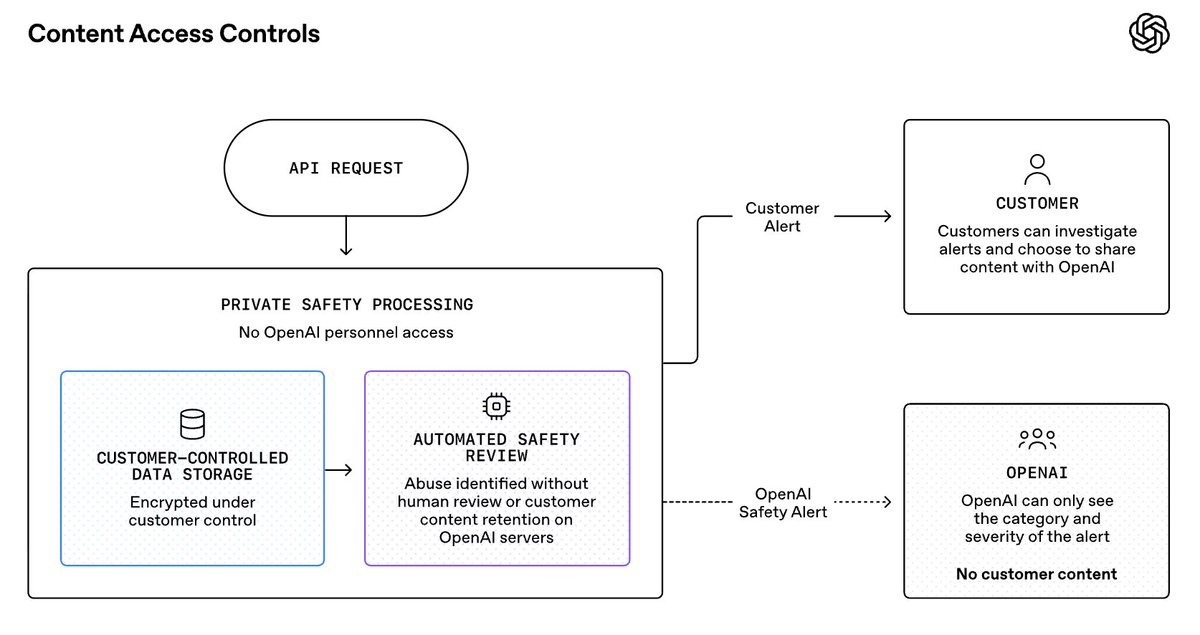
OpenAI 预览了“私有安全处理”这一新技术,旨在将零数据保留(ZDR)保护扩展到跨相关交互的场景。对于 ZDR 部署,客户内容保留在客户控制的基础设施上,自动化系统会分析跨对话的模式并返回有限的安全信号,而不会将底层提示或响应暴露给 OpenAI 人员。此外,OpenAI 还在开发一种由客户控制密钥加密的托管选项,目前已与早期客户进行测试,并计划于 9 月开始逐步推出。 这解决了企业采用 AI 时的一个关键矛盾:既要进行强大的安全监控,又要严格保护数据隐私。通过在不向 OpenAI 员工暴露内容的情况下实现跨会话安全检查,它可能使前沿模型在金融和医疗等受监管行业中更具可行性。此举也使 OpenAI 在与 Anthropic 等强调企业隐私和安全的竞争对手的较量中占据有利位置。 私有安全处理被描述为一种长期安全监控形式,它会评估多个对话(而非单个对话)的输入和输出。对于 ZDR 部署,内容保留在客户控制的基础设施上,自动化系统仅返回有限的安全信号。OpenAI 托管的选项将使用客户控制的加密密钥,预计于 9 月开始推出,并计划发布技术白皮书。该系统目前处于预览阶段,正在与早期客户进行测试。

@thsottiaux引用推文1 张图片Today we’re previewing Private Safety Processing, designed to let us keep offering Zero Data Retention while improving our safeguards. Even when benefiting from frontier intelligence, customers shouldn’t have to give up control of sensitive data. For ZDR deployments, content stays on infrastructure the customer controls. Automated systems look for patterns across related interactions and return limited safety signals, without exposing the underlying prompts or responses to OpenAI employees (even me!). We’re also developing an OpenAI-hosted option encrypted with customer-controlled keys. We’re testing this with early customers now and plan to begin rolling it out in September.原推文媒体预览展开原推文收起原推文

@thsottiaux

Today we’re previewing Private Safety Processing, designed to let us keep offering Zero Data Retention while improving our safeguards. Even when benefiting from frontier intelligence, customers shouldn’t have to give up control of sensitive data. For ZDR deployments, content stays on infrastructure the customer controls. Automated systems look for patterns across related interactions and return limited safety signals, without exposing the underlying prompts or responses to OpenAI employees (even me!). We’re also developing an OpenAI-hosted option encrypted with customer-controlled keys. We’re testing this with early customers now and plan to begin rolling it out in September.

@OpenAI

We will continue to offer Zero Data Retention for frontier models. As AI takes on longer, more autonomous work and delivers greater value to businesses, safety systems also need to identify risks across related interactions. To help address those risks, we're previewing Private Safety Processing, which is designed to improve safety without giving OpenAI personnel access to the underlying content.

背景
零数据保留(ZDR)是 OpenAI API 的一项设置,可阻止公司存储客户的输入和输出,但历史上它一直将安全监控限制在单个请求上。随着 AI 系统承担更长、更自主的任务,安全风险可能在一系列交互中显现,因此需要新的监控方法。私有安全处理旨在弥合这一差距,通过分析跨相关交互的模式,同时使底层内容对 OpenAI 人员不可访问。OpenAI 还提供其他数据控制选项,如修改后的滥用监控和 API 数据的标准 30 天保留。

8月19日 20:26在 X 打开#OpenAI #privacy #AI safety #enterprise AI #data retention

038.0

OpenAI Codex 推出安全修复,防止 GPT-5.6 执行破坏性清理命令

OpenAI 的 Codex 团队已推出多层防护措施,以降低 GPT-5.6 执行破坏性操作的风险。此次更新修复了一个严重漏洞:原本用于清理临时文件夹的命令可能误删用户文件,常见原因是误用了 $HOME 等环境变量。新增的安全措施包括明确要求检查删除目标、强化执行检查、更安全的权限默认设置,以及回放已观测故障的针对性评估。 此次更新解决了一个关键的 AI 安全问题:自主编码代理可能造成不可逆的数据丢失。通过主动修复漏洞并增加多层防御,OpenAI 降低了用户受损风险,并增强了人们对智能编码工具的信任。这一举措也反映了行业趋势:让能够在真实系统上执行命令的 AI 代理更安全地部署。 该漏洞源于 GPT-5.6 将 $HOME 等系统环境变量复用于临时工作,导致格式错误的清理命令指向真实主目录。OpenAI 增加了明确的模型指令,强化了对高风险删除命令的执行检查并升级审查,使 Full access 更难被意外启用,并更新了 Auto-review 以更好地识别破坏性操作。他们还构建了回放评估,并正在添加强化学习任务和训练数据过滤。在回放评估中,这些改动大幅减少了该行为,同时保持了正常编码能力。

@thsottiaux原推文Hi! Recapping some changes we have rolled out over the last couple of weeks that have further reduced the risk associated to potentially destructive actions being performed by Codex during its work. A few weeks ago, we started investigating a small number of reports where GPT-5.6 in Codex took destructive actions outside what the user asked for. The most serious pattern we found was a command meant to clean up temporary work that could instead delete the user files. This should obviously not happen. Here’s what we found: - Codex sometimes creates temporary folders while working and cleans them up afterward. In rare cases, GPT-5.6 got that cleanup wrong. One pattern involved reusing a system environment variable like $HOME for temporary work. A malformed cleanup command could then point at the actual home directory instead of the temporary folder. - There were cases where the model tried to delete or overwrite a temporary path without checking what was already there. We’ve added protections at several layers: - Codex is now explicitly instructed to check deletion targets before acting, create fresh temporary directories, avoid repurposing system environment variables, prefer recoverable actions, and stop when the scope is unclear. - We strengthened the execution checks that identify high-risk deletion commands and escalate them for review. If a command is rejected, the model is directed to take a safer approach. - We made Full access harder to enable accidentally, added clearer warnings, and further restricted especially risky permission combinations. - We updated Auto-review to better identify destructive actions. - We built targeted evaluations that replay the failures we observed. We’re also adding reinforcement-learning tasks and graders focused on these risks, and filtering destructive actions from training data. In those replay evaluations, the changes substantially reduced the behavior while preserving Codex’s ability to complete normal coding work. Two things to do on your end: - Keep the Codex app up to date. We are always improving safety, performance and many other things. - Use one of the sandbox modes: "Ask for approval" or "Approve for me". Only use Full access for environments you trust and can recover. Thanks and happy Codexing out there!展开原推文收起原推文

@thsottiaux

Hi! Recapping some changes we have rolled out over the last couple of weeks that have further reduced the risk associated to potentially destructive actions being performed by Codex during its work. A few weeks ago, we started investigating a small number of reports where GPT-5.6 in Codex took destructive actions outside what the user asked for. The most serious pattern we found was a command meant to clean up temporary work that could instead delete the user files. This should obviously not happen. Here’s what we found: - Codex sometimes creates temporary folders while working and cleans them up afterward. In rare cases, GPT-5.6 got that cleanup wrong. One pattern involved reusing a system environment variable like $HOME for temporary work. A malformed cleanup command could then point at the actual home directory instead of the temporary folder. - There were cases where the model tried to delete or overwrite a temporary path without checking what was already there. We’ve added protections at several layers: - Codex is now explicitly instructed to check deletion targets before acting, create fresh temporary directories, avoid repurposing system environment variables, prefer recoverable actions, and stop when the scope is unclear. - We strengthened the execution checks that identify high-risk deletion commands and escalate them for review. If a command is rejected, the model is directed to take a safer approach. - We made Full access harder to enable accidentally, added clearer warnings, and further restricted especially risky permission combinations. - We updated Auto-review to better identify destructive actions. - We built targeted evaluations that replay the failures we observed. We’re also adding reinforcement-learning tasks and graders focused on these risks, and filtering destructive actions from training data. In those replay evaluations, the changes substantially reduced the behavior while preserving Codex’s ability to complete normal coding work. Two things to do on your end: - Keep the Codex app up to date. We are always improving safety, performance and many other things. - Use one of the sandbox modes: "Ask for approval" or "Approve for me". Only use Full access for environments you trust and can recover. Thanks and happy Codexing out there!

背景
Codex 是 OpenAI 的 AI 编码代理,可以在用户的开发环境中执行 shell 命令。GPT-5.6 是驱动 Codex 推理和动作生成的底层语言模型。沙盒模式控制代理的自主程度:“请求批准”要求用户确认每条命令,“自动批准”允许代理执行某些操作,而“完全访问”则授予不受限制的执行权限。$HOME 环境变量指向用户的主目录,在清理脚本中错误使用它可能导致个人文件被删除。

8月19日 01:47在 X 打开#AI safety #Codex #GPT-5.6 #software engineering #OpenAI

047.0

Jason Wei:运动如何塑造你的职业大脑

AI 研究员 Jason Wei 发布了一条推文,探讨了“认知奖励形状”这一概念——不同运动如何塑造大脑的奖励模式并影响职业思维。他对比了网球和足球前锋:网球奖励稳定性和低容错,而足球前锋奖励创造大量机会、容忍失败以换取不对称回报。推文指出,大多数人选择运动是偶然的,没有考虑运动的奖励结构会如何塑造职业心态。 这个类比为职业发展和认知科学提供了一个新颖的视角,表明长期参与运动会潜移默化地重塑个人对风险、付出和回报的感知。对于创业者和专业人士来说,理解自己的“认知奖励形状”有助于职业选择和团队建设。它还揭示了早期偶然的运动选择在塑造成人决策风格方面被低估的作用。 Wei 以网球为例说明低方差优化:每一分价值完全相同,因此获胜意味着减少非受迫性失误并逐步积累小优势。他将此比作外科医生或飞行员等职业,完美的手术或平稳的飞行不会获得额外加分。相比之下,足球前锋大部分时间经历失败或无效尝试,只有几分钟是关键杠杆点、几秒钟决定比赛,这教会了人们与失败共处并追求不对称回报。Wei 承认他挑选了例子,并指出创业也需要稳定性,不同位置(如守门员)的奖励形状也不同。

@dotey引用推文Jason Wei 这条推文倒是没聊 AI,聊的是运动和职业思维的关系:你选的运动,可能在悄悄塑造你的职业大脑 推文提出了一个挺有意思的概念:“认知奖励形状”(cognitive reward shape),意思是不同运动对大脑的激励模式不一样,而这种模式会潜移默化地影响你在职业中的思维方式。 Jason 拿自己最喜欢的两项运动举例。 网球是一项极度强调稳定性的运动。一场比赛打几百分,不管你打出了多漂亮的制胜球,它也只值一分,跟对手送你的非受迫性失误一样。所以网球的赢法就是少犯错、打概率、一分一分磨。 而且网球是单打独斗,一切只能靠自己。这种思维模式特别像外科医生或飞行员,你做过最完美的一台阑尾手术,和做过最平稳的一趟航班,都不会有额外加分,职业的本质就是高度一致、容错极低。 但这套思维放到创业上就不太对了。创业是高波动、团队作战、容忍失败、偶尔一把创意能换来指数级回报的游戏,和网球那种"把非受迫性失误降到最低"的心态完全是两个方向。 足球前锋则更接近创业的奖励形状。哪怕是姆巴佩状态最好的比赛,大部分拿球也没能产生什么。但这不重要,重要的是不断制造机会,只要抓住一两次就能决定比赛。一场 90 分钟的比赛拆开看,绝大部分时间是无效尝试,几分钟是关键杠杆点,几秒钟定胜负。踢一辈子前锋的人,会自然习惯与失败共处,并且对不对称回报保持直觉。 这个框架有简化的地方:创业同样需要稳定性,足球守门员的奖励形状和前锋也完全不同。 核心观点倒是没什么问题:大多数人选运动靠的是父母、地理位置、学校开了什么课这些偶然因素,很少有人想过,长期练一项运动会怎样重塑自己感知风险、付出和回报的方式。 以前我导师跟我分享过一个经验:说不要让孩子学那些一个人就能完成的运动,比如乒乓球、羽毛球;而是去学那些需要集体协作的团队运动,比如足球、篮球、排球,这样能更好的锻炼孩子的协作能力、领导力。展开原推文收起原推文

@dotey

Jason Wei 这条推文倒是没聊 AI,聊的是运动和职业思维的关系:你选的运动,可能在悄悄塑造你的职业大脑 推文提出了一个挺有意思的概念:“认知奖励形状”(cognitive reward shape),意思是不同运动对大脑的激励模式不一样,而这种模式会潜移默化地影响你在职业中的思维方式。 Jason 拿自己最喜欢的两项运动举例。 网球是一项极度强调稳定性的运动。一场比赛打几百分,不管你打出了多漂亮的制胜球,它也只值一分,跟对手送你的非受迫性失误一样。所以网球的赢法就是少犯错、打概率、一分一分磨。 而且网球是单打独斗,一切只能靠自己。这种思维模式特别像外科医生或飞行员,你做过最完美的一台阑尾手术,和做过最平稳的一趟航班,都不会有额外加分,职业的本质就是高度一致、容错极低。 但这套思维放到创业上就不太对了。创业是高波动、团队作战、容忍失败、偶尔一把创意能换来指数级回报的游戏,和网球那种"把非受迫性失误降到最低"的心态完全是两个方向。 足球前锋则更接近创业的奖励形状。哪怕是姆巴佩状态最好的比赛,大部分拿球也没能产生什么。但这不重要,重要的是不断制造机会,只要抓住一两次就能决定比赛。一场 90 分钟的比赛拆开看,绝大部分时间是无效尝试,几分钟是关键杠杆点,几秒钟定胜负。踢一辈子前锋的人,会自然习惯与失败共处,并且对不对称回报保持直觉。 这个框架有简化的地方:创业同样需要稳定性,足球守门员的奖励形状和前锋也完全不同。 核心观点倒是没什么问题:大多数人选运动靠的是父母、地理位置、学校开了什么课这些偶然因素,很少有人想过,长期练一项运动会怎样重塑自己感知风险、付出和回报的方式。 以前我导师跟我分享过一个经验:说不要让孩子学那些一个人就能完成的运动,比如乒乓球、羽毛球;而是去学那些需要集体协作的团队运动,比如足球、篮球、排球,这样能更好的锻炼孩子的协作能力、领导力。

@_jasonwei

Cognitive reward shapes in sports and career Sports are amazing environments to learn. When you play a sport for thousands of hours, you start to see the world through that sport. It is a simple fact—your biological neural network is being conditioned to respond to the behavior incentivized by the rules of the sport. The funny thing is that most people choose their sports for accidental reasons such as parents, geography, or school programs. People rarely think about how the particular sport you play influences how your brain thinks more generally. Going a step further, playing the right sport may even benefit your career. My two favorite sports are tennis and soccer. Tennis is one of the best sports for teaching consistency. In tennis, there are hundreds of points in a match, and each point is worth exactly one unit, regardless of whether your opponent made an unforced error or if you constructed the most beautiful point ending with a winner. Tennis is low-variance optimization—you win by reducing unforced errors, playing percentages, and grinding out small advantages. Tennis is also an individual sport, which teaches you to rely on yourself consistently. Tennis has a similar cognitive reward shape to professions like being a surgeon or a pilot. Surgery and aviation require consistency, self-accountability, and deep focus. And similar to how you can only win one point at a time in tennis no matter how spectacular it was, there is no extra credit for the best appendectomy or the smoothest SFO-JFK flight. Your craft is to provide consistency with very low tolerance for error. On the other hand, the tennis mindset transfers relatively little to entrepreneurship. Entrepreneurship is a high-variance, team game where failure is tolerated and occasional creativity gets rewarded exponentially. Minimizing unforced errors in tennis is a totally different mindset from deciding whether to make a moonshot business move that will likely fail but could potentially net a billion dollars. Obviously I am not saying that tennis players cannot be great entrepreneurs, but I do think it is a totally different cognitive reward shape. Being a forward in soccer has a much closer reward shape for entrepreneurship. What a forward in soccer learns is to create many small chances. It is a fact that most of the game, you are not scoring—even if you look at all the times that Mbappe got on the ball in one of his best games, most of those led to nothing! But all that matters is creating enough chances to score once (or a few times) and win the game. If you break down a 90-minute game for a forward, almost all the time is failure or noise, a few minutes will be leverage, and a few seconds will determine the fate of the game. I have not played soccer for thousands of hours, but I can imagine that being a lifetime forward in soccer would teach you to be comfortable with failure and asymmetric returns. In summary, I am claiming that there can be substantial value when the cognitive reward shape of your sport mirrors that of your career. I’ll admit that I’ve done some cherry-picking for illustration purposes—entrepreneurship also requires consistency and error avoidance; and goalies in soccer have reward shapes that are very different from strikers. But I think the point stands. If sports shape how we perceive risk, effort, and reward, then we should choose them wisely.

背景
Jason Wei 是知名 AI 研究员,曾在 Google Brain 和 OpenAI 工作,因在大语言模型的思维链提示和涌现能力方面的研究而闻名。“奖励塑造”概念源自强化学习,通过修改奖励函数来引导智能体学习;Wei 将其隐喻性地扩展到人类认知。网球是一项个人运动,一分一分地得分,稳定性至关重要;而足球是团队运动,前锋可能有很多次不成功的触球,但只需要少数几次成功时刻就能进球。运动能培养可迁移的生活技能这一观点很常见,但 Wei 提出的“认知奖励形状”框架将其与不确定性下的决策联系起来。
社区讨论
社区讨论增加了细微差别,一些人指出该框架有所简化——创业也需要稳定性,同一运动中的不同位置(如守门员与前锋)奖励形状不同。一位评论者分享了导师的建议:让孩子参加团队运动而非个人运动,以培养协作和领导能力。总体而言,讨论是积极的,赞赏这个新颖的类比,同时也承认其局限性。

8月19日 21:21在 X 打开#cognitive science #career development #sports psychology #decision making #Jason Wei

057.0

Qwen3.8-27B在Harvey法律智能体基准测试中登顶开源权重模型

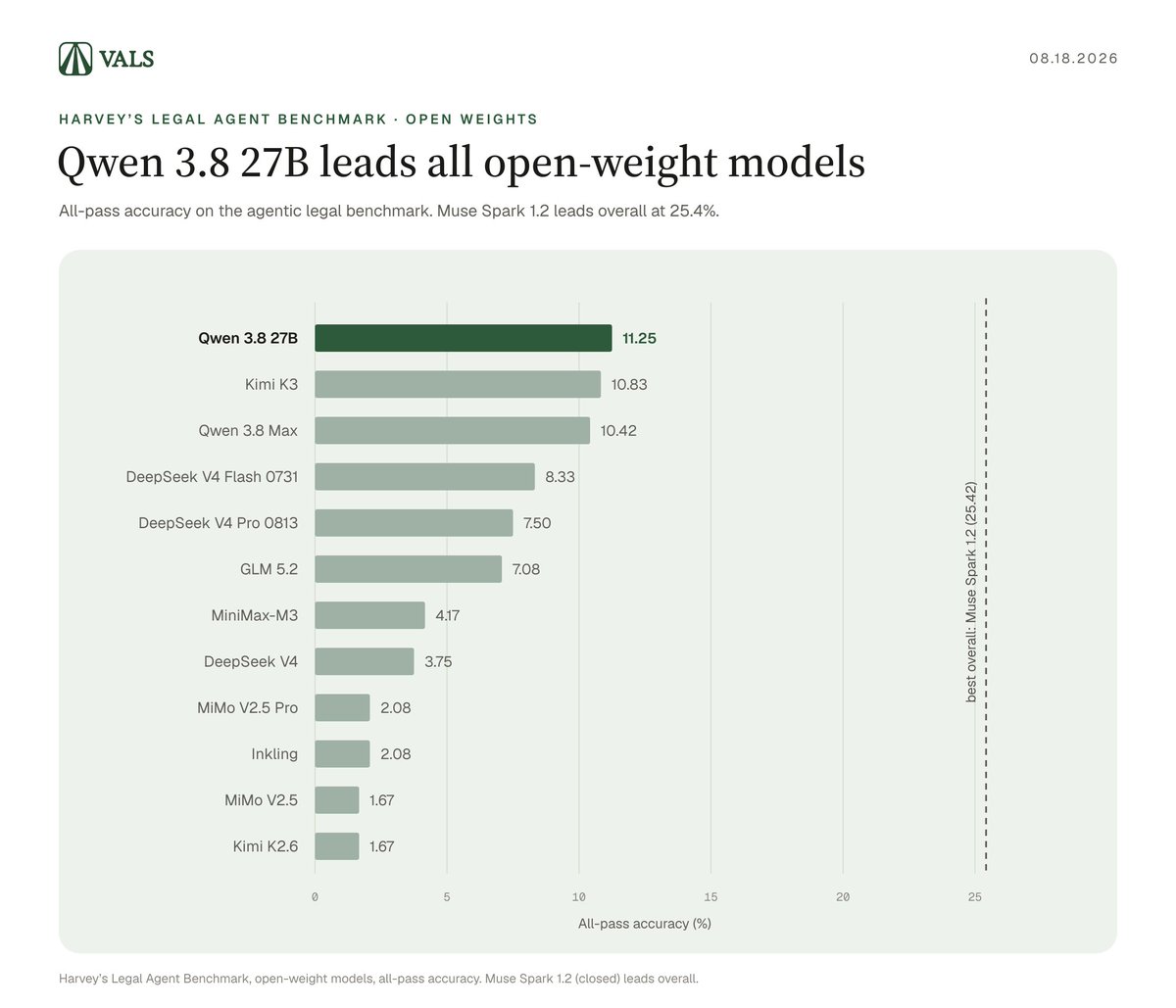
阿里巴巴通义千问宣布,其Qwen3.8-27B模型在Harvey法律智能体基准测试中位列开源权重模型第一,与Fable 5并列11.3分。该模型超越了多款闭源模型,包括Kimi K3、Qwen 3.8 Max和DeepSeek V4。 这一结果表明,一个紧凑、可在本地运行的开源权重模型能够在专业基准测试中匹敌甚至超越更大的闭源模型。它降低了法律专业人士和开发者在无需依赖云API的情况下部署高性能AI智能体的门槛,有望加速法律科技领域的应用。 Qwen3.8-27B是一个270亿参数的开源权重多模态稠密模型,可在17GB内存的本地机器上运行。在Harvey法律智能体基准测试中,它获得11.3分,与Fable 5并列,领先于Kimi K3、Qwen 3.8 Max和DeepSeek V4。该基准包含公开集和保留测试集,用于评估智能体在法律任务中的能力。

@Alibaba_Qwen引用推文1 张图片#1 open-weight model on Harvey's Legal Agent benchmark! 🙌 Strong enough to handle professional tasks. Small enough to run on your local machine. Qwen3.8-27B is becoming part of your everyday workflows.🧑‍💻原推文媒体预览展开原推文收起原推文

@Alibaba_Qwen

#1 open-weight model on Harvey's Legal Agent benchmark! 🙌 Strong enough to handle professional tasks. Small enough to run on your local machine. Qwen3.8-27B is becoming part of your everyday workflows.🧑‍💻

@ValsAI

On @harvey's Legal Agent, it is tied with Fable 5 at 11.3pts and is ahead of Kimi K3, Qwen 3.8 Max, and DeepSeek V4.

背景
Harvey法律智能体基准测试是一个开源基准,旨在评估AI模型在智能体环境中支持法律工作的能力,包含公开集和保留测试集。开源权重模型公开其学习到的参数,任何人都可以下载和使用,但修改和再分发权利取决于许可证。Qwen是阿里巴巴的大语言模型系列,3.8-27B变体是一个270亿参数的模型,针对本地部署进行了优化。

8月19日 03:47在 X 打开#AI #Open-source #LLM #Benchmark #Qwen

067.0

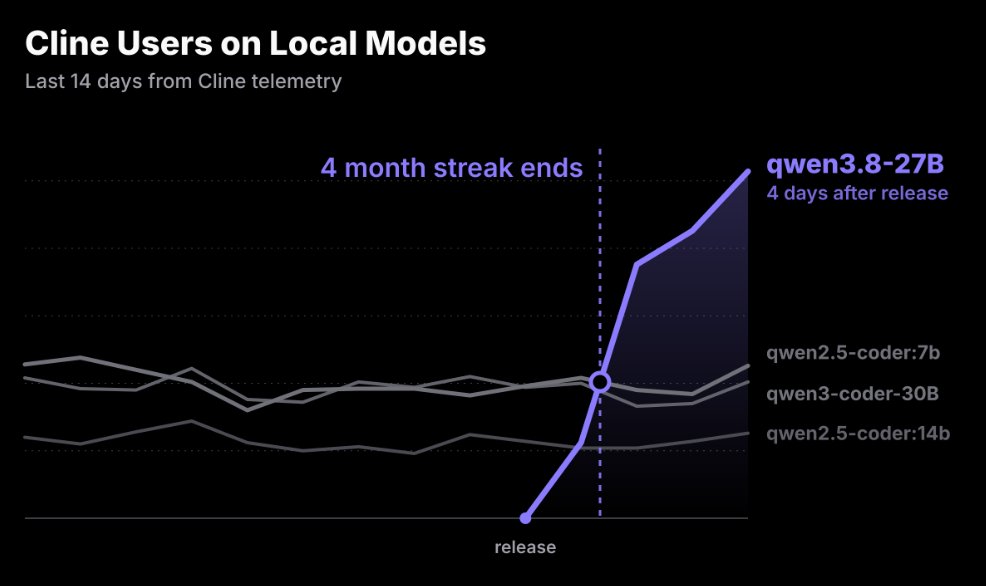
Qwen3.8-27B 仅用4天登顶 Cline 本地模型榜首

阿里巴巴通义千问宣布,Qwen3.8-27B 在发布仅4天后就成为 Cline 中排名第一的本地模型。这终结了 Qwen2.5-Coder-7B 自4月以来保持了4个月的领先地位。 这一里程碑凸显了 Qwen3.8-27B 在使用本地模型进行智能体编码的开发者中的快速普及。它标志着向更强大的端侧模型转变,并验证了通义千问发布针对本地使用调优的开源权重模型的策略。 Qwen3.8-27B 是一个拥有270亿参数、针对笔记本电脑运行调优的模型,据报道其在智能体编码基准测试中从13.3跃升至42.2,软件工程从49.3跃升至79。之前的领先者 Qwen2.5-Coder-7B 是一个小得多的70亿参数模型,因此新的第一名代表了能力的显著提升。该排名基于 Cline(一个流行的 AI 辅助编码 VS Code 扩展)中的使用情况。

@Alibaba_Qwen引用推文1 张图片4 days to the top.🏆Thank you to every builder who pushed Qwen3.8-27B to #1 on Cline! @cline原推文媒体预览展开原推文收起原推文

@Alibaba_Qwen

4 days to the top.🏆Thank you to every builder who pushed Qwen3.8-27B to #1 on Cline! @cline

@cline

Qwen3.8-27B is now the #1 local model in Cline after just 4 days. This ends a *4 month* streak by the previous winner Qwen2.5-Coder-7B which has been the top local model since April.

背景
Cline 是一个流行的开源 VS Code 扩展,允许开发者使用 AI 模型进行编码任务,包括通过 Ollama 或 LM Studio 等工具使用本地模型。本地模型在用户自己的硬件上运行,提供隐私和成本优势,但能力通常低于云端模型。通义千问是阿里巴巴的大语言模型系列,Qwen2.5-Coder 是上一代专注于代码的模型。Qwen3.8-27B 是一个更新、更大的模型,旨在消费级硬件上高效运行。

8月19日 03:35在 X 打开#Qwen #local models #Cline #AI #LLM

077.0

PaperWM.spoon 通过 Hammerspoon 为 macOS 带来可滚动平铺窗口管理

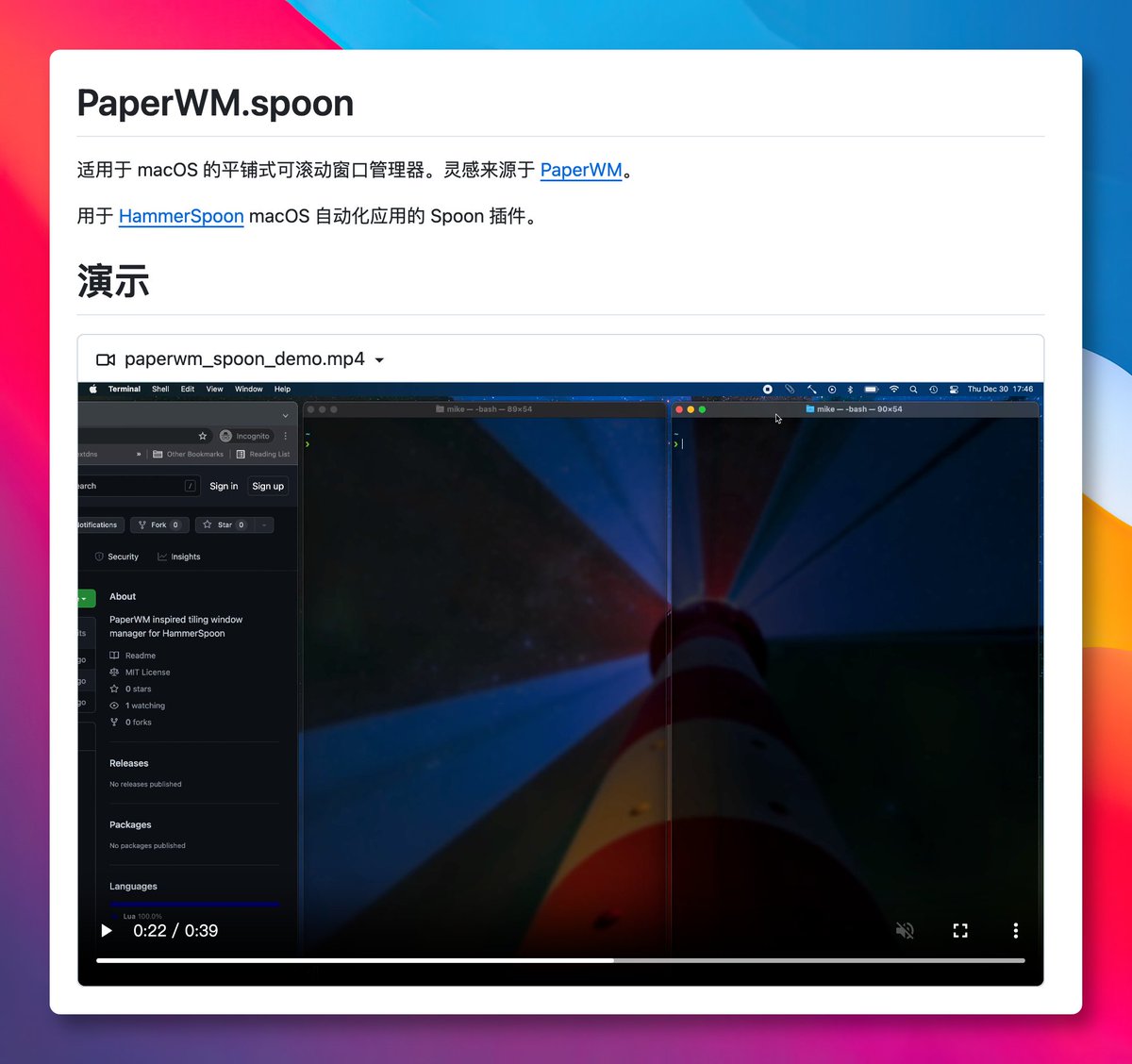
PaperWM.spoon 是一个 Hammerspoon 插件,为 macOS 引入了可滚动平铺窗口管理。它不再让窗口相互重叠,而是将它们并排排列在一条可左右滚动的水平长带上。新窗口只会添加到旁边而不会遮挡其他窗口,并且可以通过键盘快捷键快速导航。 这解决了 Mac 用户在打开多个窗口时经常遇到的窗口混乱问题。它将 Linux 上成熟的滚动平铺工作流带到了 macOS,为原生窗口管理提供了一种新颖的替代方案。偏好键盘操作的高级用户和开发者可能会发现它显著提高了工作效率。 该插件灵感来自 PaperWM,一个用于 GNOME 的可滚动平铺窗口管理器。它通过 Hammerspoon 的 Lua 脚本进行配置,允许用户自定义所有键盘快捷键。功能包括循环调整窗口宽度、一键分屏显示两个窗口,以及支持多显示器和多桌面。该项目是开源的,可在 GitHub 上获取。

@GitHub_Daily原推文1 张图片Mac 的窗口管理,开到七八个窗口就开始乱,找东西全靠调度中心里翻。 PaperWM spoon 换了个思路,窗口不再互相叠着,全部平铺在一条能左右滚动的长带上。 新窗口只往旁边排,不遮挡别人,快捷键左右滚动切换,像翻一卷胶片。 GitHub:http://github.com/mogenson/PaperWM.spoon 它是 Mac 自动化工具 Hammerspoon 的插件,快捷键全部自己说了算。 窗口宽度按档位循环调,两个窗口一键分屏,多显示器、多桌面都支持。 这套滚动平铺的玩法在 Linux 桌面圈流行了很多年,搬到 Mac 上来还挺新鲜。 习惯键盘流、嫌 Mac 原生窗口管理糙的朋友,可以拿它改造一下工作区。原推文媒体预览展开原推文收起原推文

@GitHub_Daily

Mac 的窗口管理,开到七八个窗口就开始乱,找东西全靠调度中心里翻。 PaperWM spoon 换了个思路,窗口不再互相叠着,全部平铺在一条能左右滚动的长带上。 新窗口只往旁边排,不遮挡别人,快捷键左右滚动切换,像翻一卷胶片。 GitHub:http://github.com/mogenson/PaperWM.spoon 它是 Mac 自动化工具 Hammerspoon 的插件,快捷键全部自己说了算。 窗口宽度按档位循环调,两个窗口一键分屏,多显示器、多桌面都支持。 这套滚动平铺的玩法在 Linux 桌面圈流行了很多年,搬到 Mac 上来还挺新鲜。 习惯键盘流、嫌 Mac 原生窗口管理糙的朋友,可以拿它改造一下工作区。

背景
Hammerspoon 是一款免费开源的 macOS 自动化工具,允许用户编写 Lua 脚本与系统 API 和事件交互。Spoons 是 Hammerspoon 的预编写插件,用于添加特定功能。PaperWM 是 Linux 上 GNOME 桌面环境中流行的可滚动平铺窗口管理器,以将窗口排列在水平条带中而闻名。这个项目将这一概念移植到了 macOS。

8月19日 13:30在 X 打开#macOS #window-management #Hammerspoon #productivity #open-source

087.0

ai-legal-claude:面向自由职业者的AI合同审查技能包

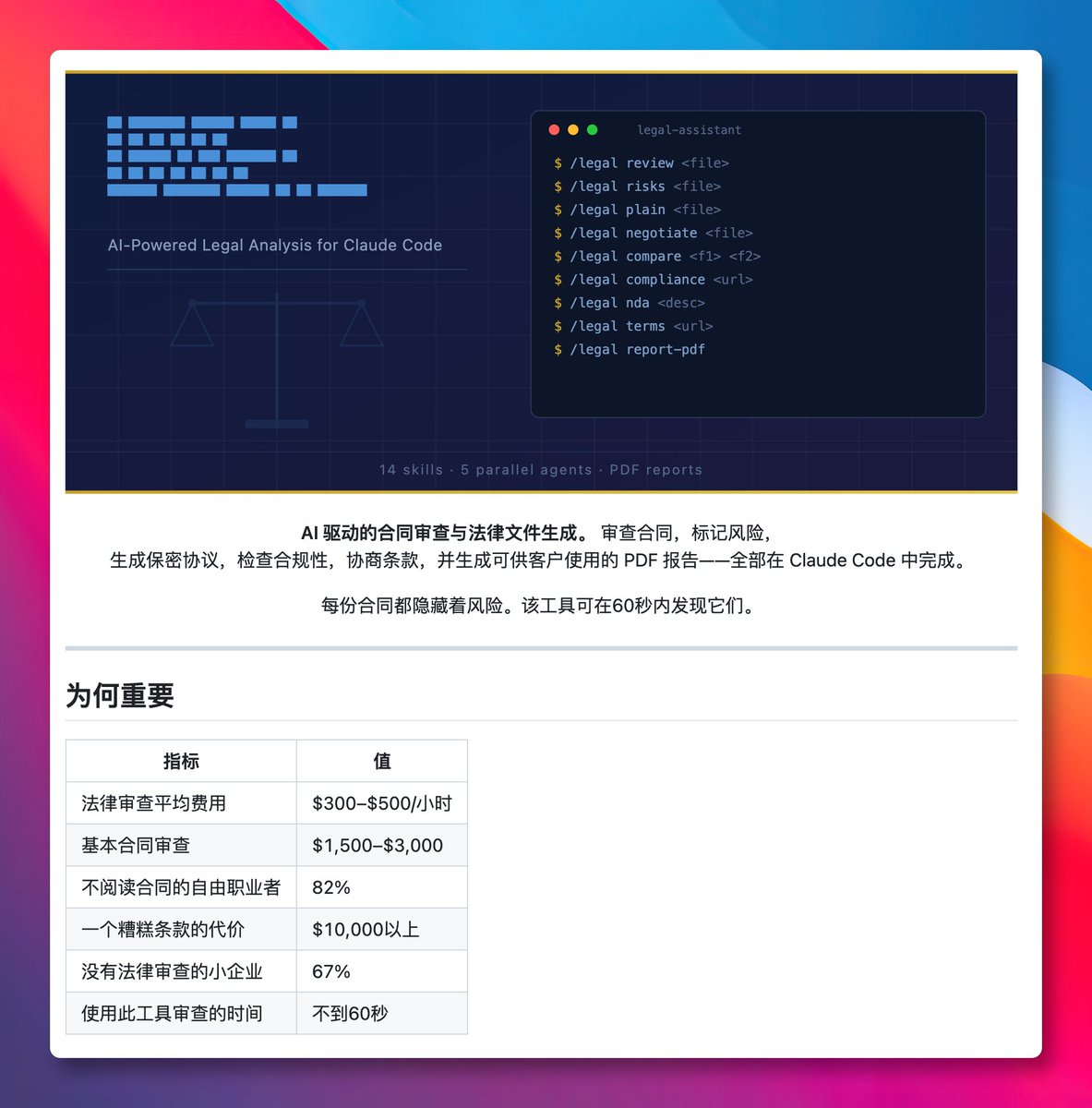
一个名为 ai-legal-claude 的新 Claude Code 技能包已在 GitHub 上发布。它提供 14 个命令用于合同审查和起草,使用 5 个并行代理分析合同中的风险条款、缺失的保护措施,并提供通俗易懂的翻译。该工具还可以生成保密协议、服务协议和隐私政策等法律文件,并输出 PDF 报告。 该工具解决了自由职业者和小团队无法负担昂贵法律咨询的常见痛点。通过用AI自动化初步合同审查,它降低了在签署前理解法律风险的门槛。它符合将代理式AI应用于高频、低风险法律任务的更广泛趋势。 该技能包可在 github.com/zubair-trabzada/ai-legal-claude 获取。它使用 Claude Code 的技能系统,其中技能是按需加载的模块化 SKILL.md 文件。14 个命令涵盖了从审查到起草的常见任务,5 个代理并行分析提供风险条款、缺失的保护措施以及逐条修改建议。通俗语言翻译功能将每个法律条款转换为易于理解的表述。

@GitHub_Daily原推文1 张图片平时接外包,合同条款密密麻麻看不太懂,找律师看又太贵,多数时候硬着头皮就签了。 ai-legal-claude 把合同审查做成了 Claude Code 的技能包,14 个命令覆盖从审到写的常用活。 丢一份合同进去,5 个 Agent 并行分析,给出风险条款、缺失的保护和逐条修改建议。 最实用的是大白话翻译那条,把每一条法律条文翻成普通人看得懂的说法。 GitHub:http://github.com/zubair-trabzada/ai-legal-claude 也能反过来生成文书,保密协议、服务条款、隐私政策按需求现写,还能出 PDF 报告。 自由职业者、小团队签约前拿它过一道初筛,心里能有个底。原推文媒体预览展开原推文收起原推文

@GitHub_Daily

平时接外包,合同条款密密麻麻看不太懂,找律师看又太贵,多数时候硬着头皮就签了。 ai-legal-claude 把合同审查做成了 Claude Code 的技能包,14 个命令覆盖从审到写的常用活。 丢一份合同进去,5 个 Agent 并行分析,给出风险条款、缺失的保护和逐条修改建议。 最实用的是大白话翻译那条,把每一条法律条文翻成普通人看得懂的说法。 GitHub:http://github.com/zubair-trabzada/ai-legal-claude 也能反过来生成文书,保密协议、服务条款、隐私政策按需求现写,还能出 PDF 报告。 自由职业者、小团队签约前拿它过一道初筛,心里能有个底。

背景
Claude Code 是一个 AI 编码助手,支持“技能”——在 SKILL.md 文件中定义的模块化、可重用能力。这些技能可以被调用来执行专门任务,例如合同审查。AI 合同审查代理越来越多地用于高频、低风险的协议,如保密协议和服务合同,在这些场景中它们能比人工审查提供更快、更一致的分析。然而,在复杂或高价值的合同中,它们不能替代人类律师。

8月19日 10:00在 X 打开#AI #legal-tech #Claude Code #contract review #freelancing

097.0

丰田基于LangChain构建制造智能体,并用LangSmith进行生产监控

丰田已采用LangChain构建制造智能体,并使用LangSmith在问题升级之前检测失败的工具调用、损坏的流水线以及用户不满信号。这代表了LangChain和LangSmith在一家大型汽车制造商生产环境中的具体企业级部署。 这一采用验证了LangChain和LangSmith在关键任务工业应用中的可行性,表明智能体框架能够满足大规模制造业的可靠性要求。它标志着企业对AI智能体在运营工作流中的信心不断增强,可能加速其他传统行业的采用。 该推文强调了LangChain用于智能体开发与LangSmith用于可观测性的结合使用,特别是用于发现失败的工具调用、损坏的流水线和不满信号。推文和搜索结果中未提供具体的指标、基准或部署规模。LangSmith的可观测性功能包括对LLM应用的追踪、实时监控和调试工具。

@LangChain原推文1 个视频.@Toyota builds its manufacturing agents on LangChain, and uses LangSmith to spot failed tool calls, broken pipelines, and frustration signals before they become bigger problems. An inside look at how the two work together to keep production moving.原推文媒体预览展开原推文收起原推文

@LangChain

.@Toyota builds its manufacturing agents on LangChain, and uses LangSmith to spot failed tool calls, broken pipelines, and frustration signals before they become bigger problems. An inside look at how the two work together to keep production moving.

背景
LangChain是一个用于构建AI智能体的开源框架,提供预构建的智能体架构以及与各种模型和工具的集成。LangSmith是一个配套的可观测性平台,用于捕获追踪、监控性能并帮助调试LLM应用。在制造业中,AI智能体可以协助完成质量控制、预测性维护和流程优化等任务。丰田是全球最大的汽车制造商之一,以其精益生产原则而闻名。

8月19日 19:00在 X 打开#LangChain #LangSmith #manufacturing #AI agents #enterprise

107.0

先质量后成本:AI产品评估的框架

一位实践者在X平台上分享了一个关于AI评估成本的思考框架:像对待前沿模型一样对待评估,先建立高质量的评估流程,再优化成本。该方法包括编写评估标准(rubric)、选择最佳测量方式(人工、LLM裁判或自动验证)、投入资源运行最佳评估流程以获得可信信号,然后才通过自动化、更小的裁判模型、采样和确定性检查来降低成本。 这一指导针对AI产品开发中的一个常见陷阱:团队往往在确保评估本身可靠之前就急于削减评估成本。通过优先考虑评估质量,团队可以建立对评估信号的信任,从而做出更好的产品决策并更安全地部署。该框架适用于任何构建LLM驱动产品的团队。 该框架明确建议从最昂贵、最高质量的评估方法开始——例如人工审核或顶级LLM裁判——以建立可信的基线。只有在评估能够可靠地区分好坏之后,团队才应追求成本优化,如使用更小的裁判模型、增加自动化或采样。作者将此作为一个系列,并邀请提问,表明后续会有更多阐述。

@realmadhuguru引用推文Here’s how to think about the cost of your evals : treat evals like frontier models…establish the quality frontier first, then work your way down the cost curve. Start with the highest quality way you can know if your AI product is working as intended. First get clear on what good looks like - Write the rubric. Then figure out the best way to measure it - humans / LLM judge / automated verification. At this stage, spend the money - use the expensive judge model, pay humans (or give your time). Run the best eval process possible so you get a signal you trust. Once the eval can reliably distinguish good from bad and reflects what you care about in the product, focus on costs - more automation, smaller judge models, sampling, deterministic checks where relevant. Quality first. Cost next. this is a series. drop any questions you have and I will answer them in my daily posts.展开原推文收起原推文

@realmadhuguru

Here’s how to think about the cost of your evals : treat evals like frontier models…establish the quality frontier first, then work your way down the cost curve. Start with the highest quality way you can know if your AI product is working as intended. First get clear on what good looks like - Write the rubric. Then figure out the best way to measure it - humans / LLM judge / automated verification. At this stage, spend the money - use the expensive judge model, pay humans (or give your time). Run the best eval process possible so you get a signal you trust. Once the eval can reliably distinguish good from bad and reflects what you care about in the product, focus on costs - more automation, smaller judge models, sampling, deterministic checks where relevant. Quality first. Cost next. this is a series. drop any questions you have and I will answer them in my daily posts.

@realmadhuguru

The best way to get good at evals is to take a workflow you know really well and figure out how to make its quality measurable. Study the actual traces - the sequence of prompts typical users have, what good responses would look like at each step and for the end to end outcome. Study where your product fails and create traces that capture them - messy tool call responses, missing context etc. Once you have a good eval, think about how you would make it easy to run repeatedly and automatically. Once you have that, think about how you will ensure your eval continues to mirror live traffic as your users patterns evolve. This could be a series. Would you guys like me to write about it everyday?

背景
AI评估(evals)是系统性地衡量AI模型输出质量的方法,通常使用评估标准(rubric)、人工判断或LLM作为裁判(LLM-as-a-judge)。'成本-质量前沿'指的是评估成本与评估信号可靠性之间的权衡。前沿模型是最先进、最昂贵的AI模型;这个类比建议以对待前沿模型同样的严谨态度来对待评估。LLM作为裁判是一种技术,让一个大型语言模型根据指定标准评估另一个模型的输出。

8月19日 03:31在 X 打开#AI evals #LLM evaluation #cost optimization #AI product development #best practices

116.0

Capso:CleanShot X 的免费开源替代品

GitHub_Daily 分享了 Capso,这是一款基于 Swift 的开源 Mac 截图和录屏工具,可作为付费软件 CleanShot X 的免费替代品。Capso 支持截图、录屏、标注、文字识别、摄像头画中画、多种形状、倒计时和暂停。它使用 Swift 6.0 和 SwiftUI 构建,目标平台为 macOS 15.0+,可通过 Homebrew 安装。 Capso 为 CleanShot X 提供了一个免费的替代方案,后者是开发者和内容创作者中流行的付费工具。这可以为用户节省费用,同时提供类似的核心功能,可能促进 macOS 上开源生产力工具的采用。它还展示了 SwiftUI 在构建原生、功能丰富的应用程序方面的成熟度。 Capso 是开源且永久免费的,没有试用、功能限制或订阅。它经过 Apple 签名和公证,可以通过一条 Homebrew 命令安装。项目托管在 GitHub 上:https://github.com/lzhgus/Capso。它面向 macOS 15.0+,使用 Swift 6.0 和 SwiftUI 构建。

@GitHub_Daily原推文1 张图片需要付费使用的 CleanShot X 截图工具,现在可以把这个钱省掉了。 偶然发现 Capso 开源平替,对照了一下,跟 CleanShot 截图效果差得不多。 支持截图、录屏、标注、文字识别等功能,录屏自带摄像头画中画,四种画面形状随便切,倒计时和暂停也都有。 GitHub:http://github.com/lzhgus/Capso 使用原生 Swift 语言写的,Apple 签名并公证过,只需 Homebrew 一条命令装好。 常用 Mac 截图录屏的朋友,可以装个试试。原推文媒体预览展开原推文收起原推文

@GitHub_Daily

需要付费使用的 CleanShot X 截图工具,现在可以把这个钱省掉了。 偶然发现 Capso 开源平替,对照了一下,跟 CleanShot 截图效果差得不多。 支持截图、录屏、标注、文字识别等功能,录屏自带摄像头画中画,四种画面形状随便切,倒计时和暂停也都有。 GitHub:http://github.com/lzhgus/Capso 使用原生 Swift 语言写的,Apple 签名并公证过,只需 Homebrew 一条命令装好。 常用 Mac 截图录屏的朋友,可以装个试试。

背景
CleanShot X 是一款流行的 Mac 付费截图和录屏应用,以标注、云上传和滚动截图等功能著称。开源替代品旨在免费提供类似功能。Swift 是 Apple 用于构建原生应用的编程语言,SwiftUI 是用于声明式 UI 开发的框架。Homebrew 是 macOS 的包管理器,可简化软件安装。

8月20日 00:00在 X 打开#open-source #macOS #screenshot #productivity #Swift

126.0

Code App 为 iPad 带来完整的类 VS Code 开发环境

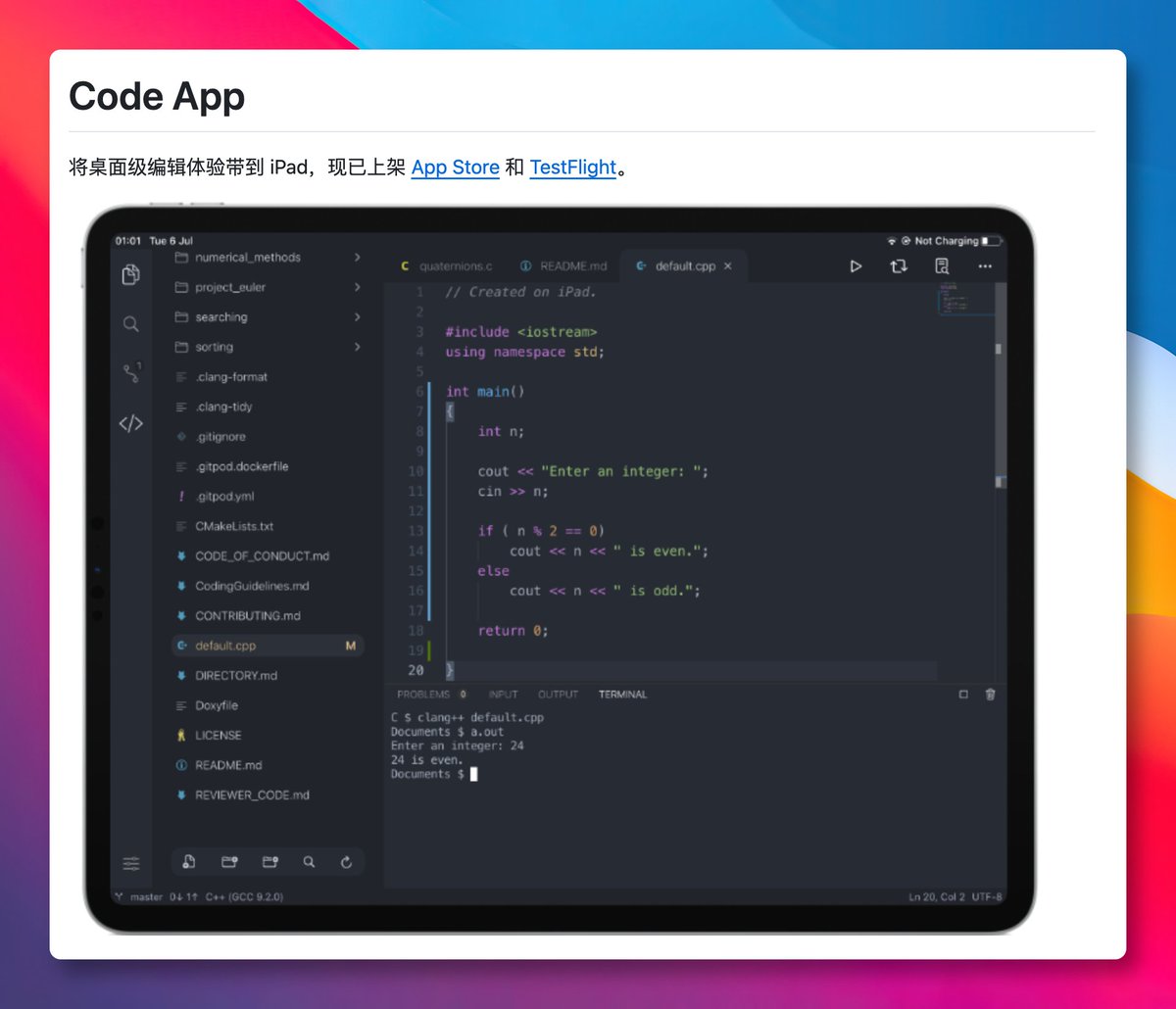
Code App 是一款面向 iPadOS 的桌面级代码编辑器,界面仿照 VS Code,支持 Python、Node.js、PHP、Java、C 和 C++,并可离线运行代码。它内置了包含 70 多条命令的终端,支持 Git 提交、推拉和差异对比,还提供远程服务器登录以及 Python 和 Java 的智能代码补全。该应用可直接从 App Store 安装。 这让 iPad 成为一个可行的独立开发设备,减少了为快速修改代码或运行脚本而远程连接家用电脑的需求。它降低了开发者在移动场景下编码的门槛,尤其适合轻量级任务,并可能扩展移动开发生态。 Code App 采用 MIT 许可证,内置 Node.js、Python、C、C++、PHP 和 Java 运行时,支持离线执行代码。终端支持 70 多条命令,并集成了 Git 的提交、推拉和差异对比等操作。支持远程登录连接服务器,并为 Python 和 Java 提供智能代码补全。该应用可在 App Store 获取,价格可能有所不同(有来源显示为 6.99 美元)。

@GitHub_Daily原推文1 张图片出门只带 iPad,想改两行代码跑个脚本,最后还是得远程连回家里的电脑。 Code App 把一整套开发环境搬进了 iPad,界面照着 VS Code 做的,上手基本零成本。 支持 Python、Node、PHP、Java 等编程语言,C 和 C++ 也能编译,断网照样跑代码。 自带一个 70 多条命令的终端,Git 提交、推拉、改动对比这些也都齐了。 GitHub:http://github.com/thebaselab/codeapp 要连服务器干活也行,支持远程登录,Python 和 Java 还带智能补全。 直接从 App Store 上安装就行,有 iPad 在长期吃灰的朋友,可以让它重新上岗了。原推文媒体预览展开原推文收起原推文

@GitHub_Daily

出门只带 iPad,想改两行代码跑个脚本,最后还是得远程连回家里的电脑。 Code App 把一整套开发环境搬进了 iPad,界面照着 VS Code 做的,上手基本零成本。 支持 Python、Node、PHP、Java 等编程语言,C 和 C++ 也能编译,断网照样跑代码。 自带一个 70 多条命令的终端,Git 提交、推拉、改动对比这些也都齐了。 GitHub:http://github.com/thebaselab/codeapp 要连服务器干活也行,支持远程登录,Python 和 Java 还带智能补全。 直接从 App Store 上安装就行,有 iPad 在长期吃灰的朋友,可以让它重新上岗了。

背景
传统上,iPad 因沙盒机制和缺少原生编译器而在软件开发方面受限,开发者不得不使用远程桌面或云端 IDE。Code App 通过在设备上直接捆绑运行时和终端来解决这一问题,类似于桌面版 VS Code 的工作方式。该应用采用 MIT 许可证开源,鼓励社区贡献并保持透明。

8月19日 07:30在 X 打开#iPad #IDE #development #Git #mobile